3 months ago
85
3 months ago
85
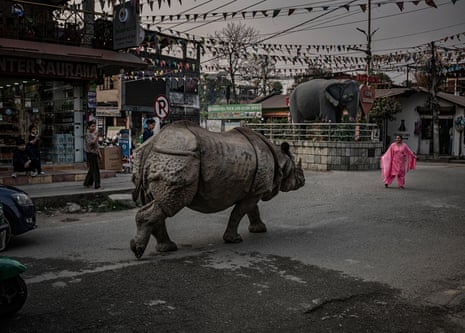
The tourists lining the steep embankment buzzed with excitement, phones out, snapping away in the twilight as a wild Indian rhinoceros grazed below the Nepali village of Sauraha. Climbing to the main street, the rhino ambled down the middle of the road.
Local people warned tourists to give it plenty of space. All manner of wheeled vehicles slowed, then passed. The rhino turned its horn at a cyclist passing too close, triggering gasps from the assembled crowd.
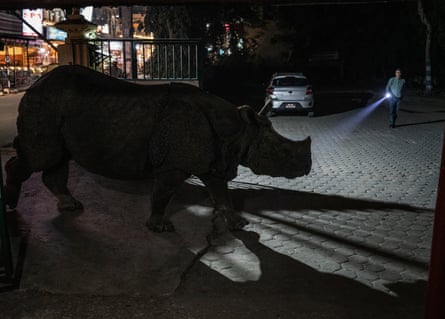
Night had fallen by the time it reached the local hotel. The rhino, illuminated by headlights, turned to enter the grounds. The hotel manager stationed himself in the parking lot and shone a strobe torch in the rhino’s eyes.
-
A manager uses torchlight to guide a wild Indian rhinoceros through the grounds of his hotel in Sauraha
Pausing momentarily, it turned, as the manager had hoped, on to the footpath through the garden, disappearing into the darkness behind the hotel.
The close encounter ended without incident, but as Nepal navigates more and more incidents of human-wildlife conflict, it is learning how to educate those most at risk.
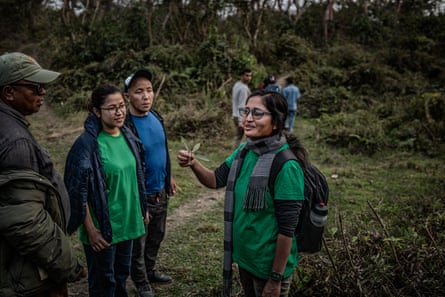
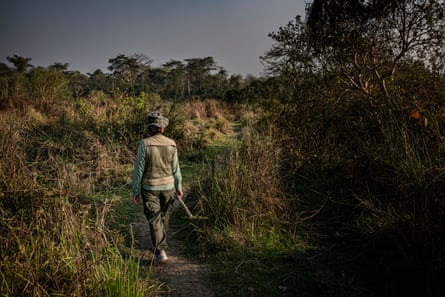
In February, Doma Paudel, Nepal’s first female trail guide and founder of the Wildlife Victim Fund, held a seven-day immersive workshop, bringing together 21 emerging environmentalists to help them develop strategies to teach community members how to coexist more safely with megafauna.
-
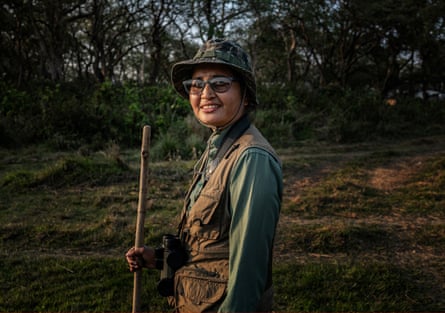
Doma Paudel, Nepal’s first female trail guide and founder of the Wildlife Victim Fund. In 2004, she lost her mother to a rhinoceros attack

-
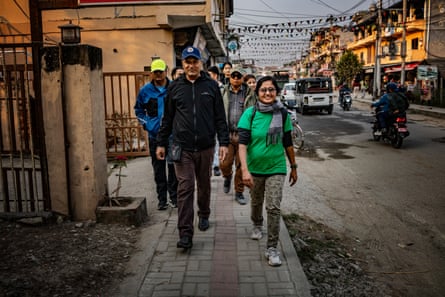
Paudel’s seven-day immersive workshop helps environmentalists develop strategies on how to respond during encounters with wildlife
“Wildlife populations are increasing and the number of [human-wildlife conflict] incidents is also rising,” she says. “This leads to growing anger, fear and concerns about livelihoods.”
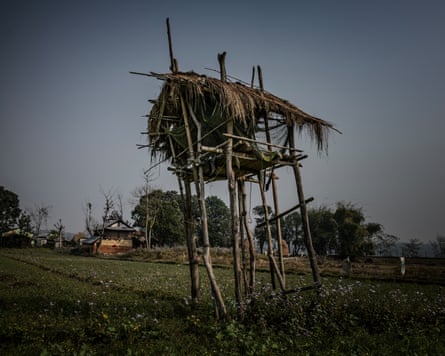
Paudel knows first-hand how important it is to promote better human-wildlife coexistence. She grew up in a small village close to forests and fields. “Our farming was most affected by wild animals. To protect our crops, we built a watchtower in the field.”
When necessary, they would spend the night in the tower, attempting to drive off wildlife that came from the adjacent complex of protected forests, with Chitwan national park at its core.

-
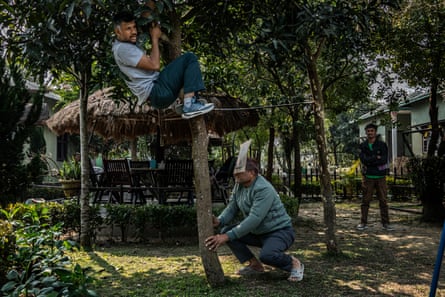
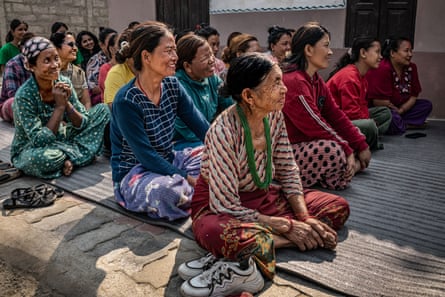
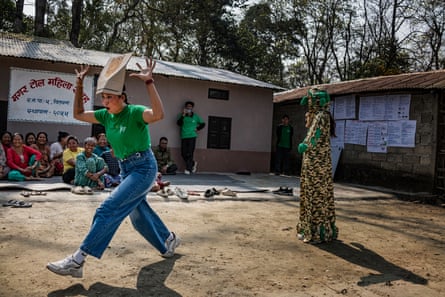
Course participants use roleplay to simulate an encounter with animals such as rhinos or tigers, and teach schoolchildren and women in villages how to respond
“Sometimes elephants even entered our home and ate all the stored food. In the beginning, my parents would have me climb trees to observe animals such as rhinoceroses, tigers and bears. Once, while cutting grass in a community forest, a leopard suddenly jumped right above my head.”
In 2004, while gathering firewood in the forest, Paudel’s mother was killed by a rhino.
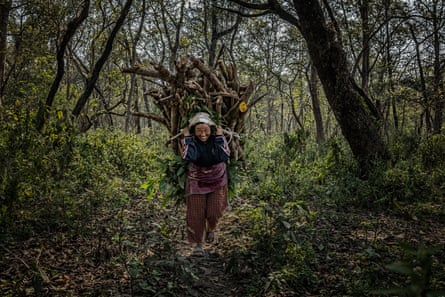
Women are most vulnerable to potentially fatal encounters with wildlife because, in traditional Nepali society, they do the bulk of gathering of firewood, wild herbs and animal fodder in the forests. Paudel’s initiative has also included visiting villages to speak to mostly women and also schools, to start preparing children for potential encounters.
-
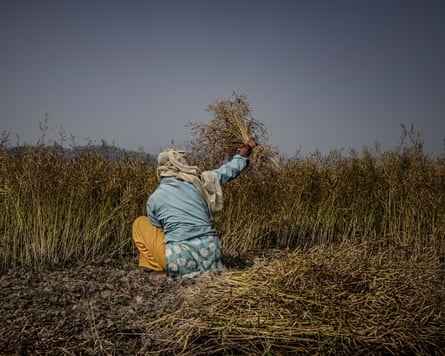
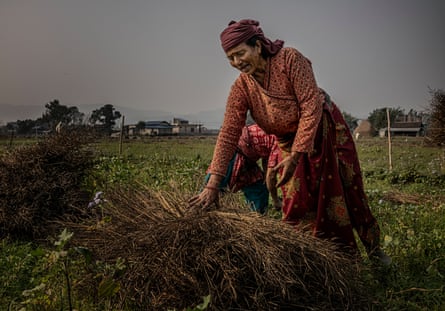
Clockwise from top left: a machan watchtower, used in the rice-growing season to look out for rhinos; a woman harvests mustard seed in the Madi valley; gathering firewood in Jankauli community forest, adjacent to Chitwan national park. Most megafauna attacks on people do not happen in the deep forest but around the edges in community forests and buffer zones
Eleven people lost their lives in megafauna encounters in 2024, eight due to rhinoceros attacks.
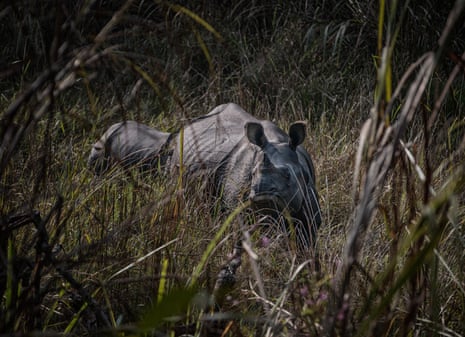
In a sense, the country has become a victim of its own conservation success. By the early 1970s, only an estimated 100 rhinos remained in the country, mostly in Chitwan national park. But, with effective anti-poaching measures and community support, that number has risen more than sevenfold, with almost 700 of them living in and around the park.
-
A female rhino and her calf among the elephant grass in Chitwan national park
“Tigers, rhinoceroses and gharials, which were once close to extinction, are now increasing thanks to joint efforts by communities and the national parks,” says Paudel.
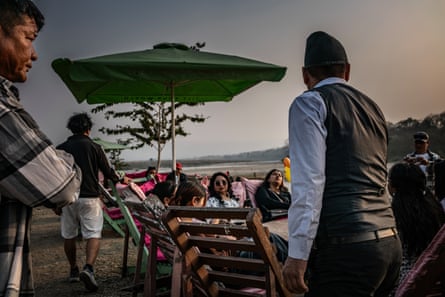
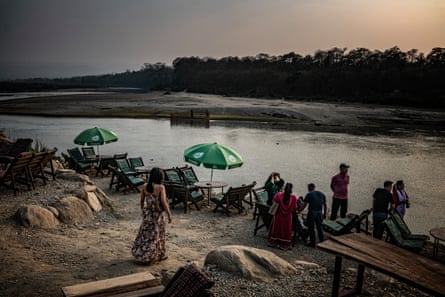
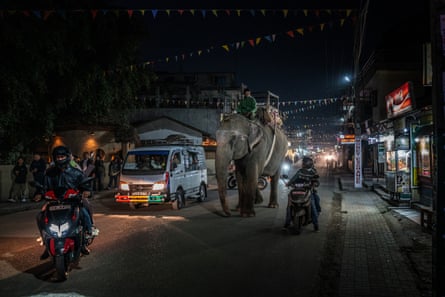
As the number of rhinos has increased, so too has the number of people, including an influx of tourists.
-
Top: tourists watch for crocodiles at a cafe in Sauraha on the banks of the Rapti River; below: an elephant is part of the traffic on the main road in Sauraha
“In this past year or so, rhinoceroses more frequently come to our fields,” says Balkrishna Bhattarai, a farmer from Shikharpur in the Madi valley, on the other side of Chitwan national park from Sauraha. “Sometimes they come right past the front of the house.”
-
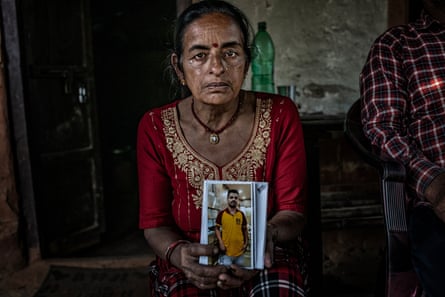
Ishori Bhattarai with a photo of her son, Ashok, who was killed by a rhinoceros
The Madi valley is surrounded by forest, with the park to the north and west, and a buffer forest to the south. An unpaved road, crossing the park, connects to the rest of Nepal.
Three weeks earlier, Bhattarai’s son, Ashok, 22, had returned home for a visit from India, where he worked as a hotel restaurant cook. “There was a rhinoceros in our field, eating the crops,” Bhattarai said. Their field of mustard seed was almost ready to harvest. “He rushed to the field and tried to chase away the rhino but the rhino charged, killing him.”
-
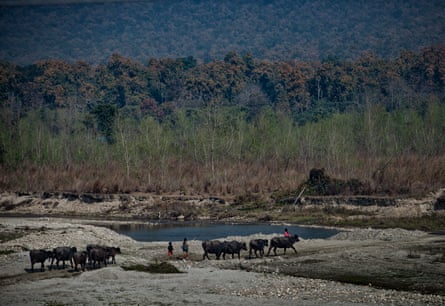
Children in the Madi valley herding water buffalo for grazing
-
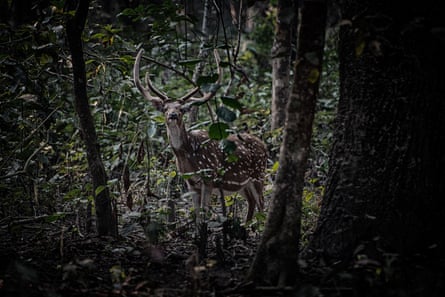
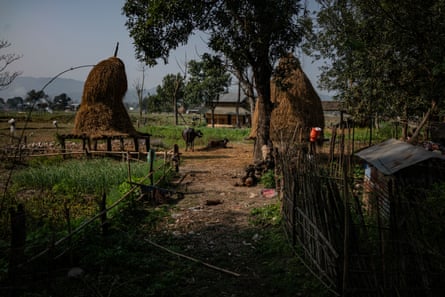
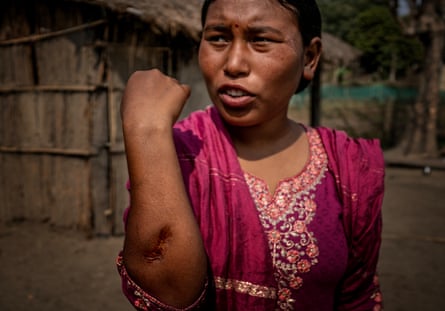
Clockwise from top left: a chital, or spotted deer, in Chitwan national park; a typical farm in the Madi valley; Archana Bote shows where a sloth bear bit and broke her arm; harvesting mustard seed in a field visited daily by a local wild rhino
A short distance away, in Pandavnagar village, Juna Bote describes the last time she saw her husband, Bhanu, 34. “We had a good conversation over breakfast before he went fishing,” says Bote.
There were, she says, five or six people in the fishing party. From the riverbank, they saw a tiger in the distance. Usually, there was relative safety in numbers. This time, though, the tiger approached, grabbing Bote and dragging him into the jungle.
-
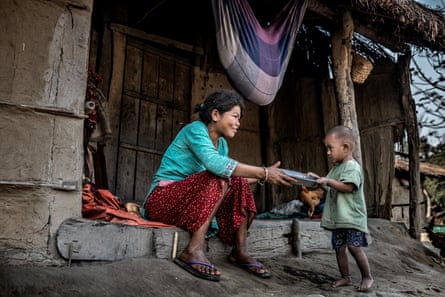
Juna Bote’s husband, Bhanu Bote, was killed by a tiger while fishing in the Madi valley
When Juna returned from collecting firewood in the forest at about 3pm, her brother-in-law told her about the incident. All the search party could find was his clothing, including a blood-stained cap. No body was ever discovered.
After 13 years of marriage, Juna was left to raise five children. “I do whatever I can to survive. I’m afraid now to enter the forest [to collect firewood to sell], but what choice do I have?” she says.
“Space is to share with other animals. If we love nature, nature will love us back.”
-
A woman steps in front of a wild Indian rhinoceros in Sauraha’s main street
Find more age of extinction coverage here, and follow the biodiversity reporters Phoebe Weston and Patrick Greenfield in the Guardian app for more nature coverage