3 months ago
49
3 months ago
49
Britain risks a financial hit worth £125bn a year from a worsening crisis in youth worklessness after a rise in the number of young people not in employment or education to more than 1 million.
In a landmark government-backed report, Alan Milburn warned that Britain’s economy and the public finances were losing billions of pounds a year amid the growing risk of a “lost generation” of young people.
The former Labour cabinet minister said youth disengagement was a mounting economic risk to the country, as he urged the government to undertake a fundamental reset of policy covering schools, the health service and the welfare state.
Figures from the Office for National Statistics on Thursday showed a rise in the number of 16- to 24-year-olds in the UK who were not in education, employment or training (Neet) in the three months to March to 1,012,000 – breaching the 1 million mark for the first time since 2013.
Speaking at the launch of his report, Milburn said the figures highlighted “probably the most significant issue the country faces” amid growing alarm over the future prospects of young people in Britain.
“It’s actually more than a statistics; it’s a warning, a warning that far too many young people are reaching adulthood only to find the door to opportunity closed,” he said.
It comes with overall unemployment in Britain now at the highest levels since the outbreak of the Covid pandemic, with young people bearing the brunt as businesses warn over the impact of tax increases and a downturn in the economy amid the fallout from the Iran war.
In a major report published on Thursday, the Milburn review said the lost contribution to the economy and cost to the state of supporting young people through the benefits system was leaving a multibillion-pound financial hole.
“[However,] the principal cost isn’t borne by the taxpayer. It’s borne by the young person; being Neet has a long-term scarring impact. Costs to their confidence, costs to their health, costs to their future income,” he said.
“It’s a deposit never saved, a home never bought, a pension never built.”
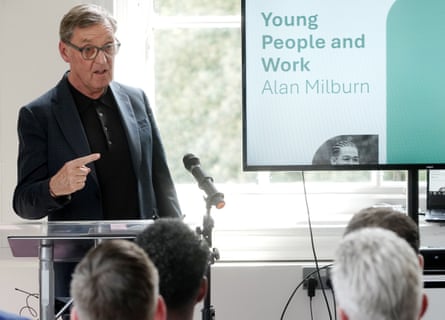
The report is the first part of Milburn’s findings before he is expected to make final recommendations to the government in the autumn.
Sounding the alarm over the long-term damage for young people, the former health secretary under Tony Blair warned the average lifetime loss in earnings because of a period of being Neet between the ages of 18 and 24 was the equivalent of £52,000 a year.
“The longer a young person is outside work or learning, the harder and more expensive it becomes to help them back. In this review we estimate the cumulative annual cost to our country of almost 1 million Neet young people at £125bn. That is more than we spend on education each year,” the report said.
“The question is no longer whether the current position is affordable. It is whether it is sustainable.”
If every young person aged 18 to 24 who was Neet was in work last year, the report found it would have contributed £38bn more to UK gross domestic product, while cutting the cost of the benefits bill for the Treasury.
The report warned that the lifetime public finance impact from a young person being Neet between the ages of 18 and 24 was equivalent to £29,000 a year on average.
In analysis showing the government spends about £8.1bn a year on benefits directly for young people through the welfare system, it said more than half – £4.4bn – was allocated to Neets.
The report showed about £3.2bn was spent on disability benefits through the personal independence payment, which is available to people in and out of work. However, the report said young people could be helped to find a job through a rise in spending on employment support and a retooling of the education system and Britain’s labour market.
Milburn estimated that £3.2bn out of the total benefits bill could have been avoided if Neet young people had been in work and earning above earnings thresholds.
He said it was “shocking and shameful” that for every £25 spent on welfare the government spent £1 on employment support. Only one in five young people who are Neet are getting meaningful help to find work, leaving young people “trapped on benefits”, he added.
“The welfare system must always protect those who cannot work … that is non negotiable. But for young people who could participate, the welfare system should be supporting them to do so. Today it is not.”
However, any fresh attempt at welfare reform could prove divisive after Starmer’s chaotic benefits U-turn last year, with concerns that welfare cuts would risk driving up poverty amid the cost of living crisis.
Speaking at the launch of the report, Pat McFadden, the work and pensions secretary, said the government had made a “major and important start” to address youth worklessness through its jobs guarantee. However, he acknowledged ministers had to take further action.
“Although I commissioned this report, I’m clear that responding to it is not just the cause of one department or one secretary of state,” he said.