3 months ago
63
3 months ago
63
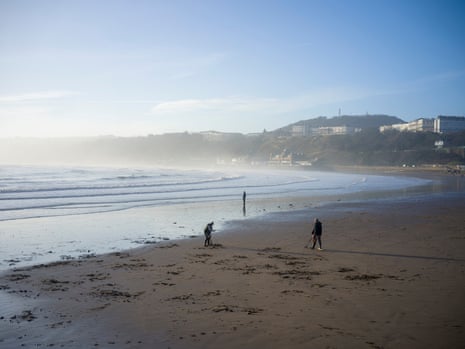
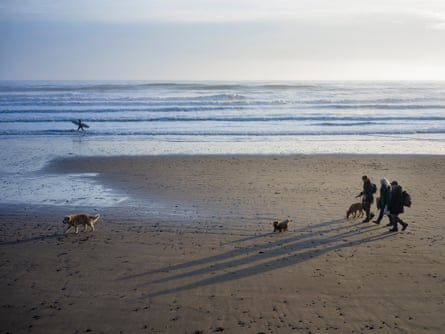
It’s the morning after a wet and stormy day in the Yorkshire seaside town of Scarborough. The waves, which the previous day had been crashing dramatically on the harbour walls, have calmed and a few brave souls have entered the water with surfboards. There is a man throwing a ball for his dog on the beach and a kayaker bobbing on the waves.
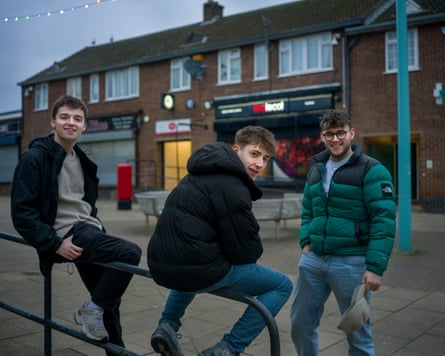
Just up from the seafront in the centre of town, Jack and Charlie, both 17, are leaning forward listening to a story from 19-year-old Keane about his recent visit to a drama school in London, where he is hoping to apply for a place on an actor training course once he has saved enough money.
“I walked outside the school and there was this girl on the phone,” he says. “I didn’t know the context of the conversation she was having but she went … ‘I just want to know now if he has left me any money,’” he says in a high-pitched posh voice.
“And I thought, ‘you won’t hear anyone say that in our town,’” he adds, as the three teenagers crack up laughing.
“It’s not that I’m slagging her off,” he hastily explains. “It’s just that something like that feels like planets away from where we are. We make money, we don’t wait for money to come to us.”
-
Scarborough, on the North Yorkshire coast, was one of England’s first seaside resorts
It is an important point of distinction that Keane, Charlie and Jack are all keen to discuss at length. What money means to families where they live, compared with more affluent places elsewhere.
Keane, who had to re-sit his English GCSE and admits he was “in trouble at school a lot”, was going to apply for an apprenticeship, encouraged by his father, who, he says, “struggled to get where he is today” and just wanted him to make money as soon as possible. But at the last minute he went with a friend to look at the sixth form of his local college and got on to the drama A-level course there.
“There were a lot of my mates growing up in school who have now got apprenticeships,” says Keane, who works as a cleaner in a local hospital to save money. “They’re working in trades in Scarborough, or maybe furthest in York.
“Not a lot of people have pursued higher education,” he says, “but that’s about money.”
What is the Against the tide series?
ShowOver the next year, the Against the Tide project from the Guardian’s Seascape team will be reporting on the lives of young people in coastal communities across England and Wales.
Young people in many of England's coastal towns are disproportionately likely to face poverty, poor housing, lower educational attainment and employment opportunities than their peers in equivalent inland areas. In the most deprived coastal towns they can be left to struggle with crumbling and stripped-back public services and transport that limit their life choices.
For the next 12 months, accompanied by the documentary photographer Polly Braden, we will travel up and down the country to port towns, seaside resorts and former fishing villages to ask 16- to 25-year-olds to tell us about their lives and how they feel about the places they live.
By putting their voices at the front and centre of our reporting, we want to examine what kind of changes they need to build the futures they want for themselves.
Before having a coffee break and a chat, the three young men had been warming up their vocal cords in the Stephen Joseph theatre, where they are part of the Young Company, a drama training programme for older children and young adults. They are going through lines from a play called Feral.
Keane wrote it as a love letter to his home town, where the character he plays, Adam, is grappling with his decision to move to Leeds. Adam wants a brighter future but he also loves where he lives. It is a dilemma faced by countless young people in British coastal towns, many of whom do not want to leave but feel they have no choice.
It was also penned in response to an article in 2023 by the Daily Express newspaper that described Scarborough with the headline: “Beautiful seaside town reduced to ‘battleground’ with ‘feral’ youths’ reign of terror.” When Keane, 17, performed Feral, the powerful monologue earned him two awards at the Scarborough Fringe festival.
-
From left: Jack, Charlie and Keane. Jack, who lives with his grandparents in Scarborough, says Eastfield, though much maligned, has ‘a special place in my heart’
Charlie is used to people with opinions on where he lives. “I’ve been judged for living there before,” he says. “People have been like, ‘oh, he’s from Eastfield, what a tramp. But they’re saying this and they don’t even know me.”
Eastfield was the area the Express article focused on. Once a suburb of Scarborough but now a separate small town that has areas that are among England’s most deprived. It is where Keane and Charlie come from and where Jack, who lives with his grandparents in Scarborough, professes to “love like home”. He adds: “It has always had a special place in my heart.”
Rob Salmon, head of creative engagement at Stephen Joseph, who is working with Keane, Charlie and Jack, says: “When there isn’t much money in a place, then people’s choices are taken away from them.
“It’s important that the voices of people who are living in that context, and who understand it, dictate how they are seen,” he says.
All three teenagers aspire to be professional actors but all of them know that it is a difficult choice to make work in a place such as Scarborough, which can feel a million miles away from anywhere.
On the Yorkshire coastline of north-east England, Scarborough lies an hour from York to the west and Hull to the south. As with every other coastal place in Britain, its geography means half of its area of opportunity is lost to water. Or, as Salmon puts it when describing the difficulties of attracting theatre audiences: “Half our catchment area is fish.”
-
‘Half our catchment area is fish,’ says one of the people behind Scarborough’s Stephen Joseph theatre
Like so many of England’s coastal resorts, the town has, in an age of cheap foreign travel, found itself passed over as a holiday destination. But this has undoubtedly been made worse by its poor transport connections, which are repeatedly cited as the bane of their lives by local people.
The train service between Scarborough and York typically runs once an hour and the road between the two places, the A64, is a single carriageway. Despite decades of pleas to widen it to deal with the congestion, there is no immediate hope of this in sight.
The Labour MP for Scarborough and Whitby, Alison Hume, recently referred to Scarborough’s poor transport connections as leaving the town “stuck in the slow lane” with “opportunity and growth being choked off”.
-
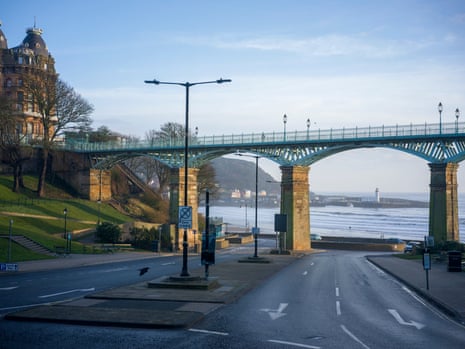
Scarborough’s Cliff Bridge. Like the 19th-century footbridge, much of the town’s transport infrastructure belongs to a bygone era
This has meaning beyond the obvious day-to day constituency frustrations for Labour. A 2024 report from the consultancy Stonehaven suggests that constituencies where Reform have been elected (Great Yarmouth, Boston & Skegness, Clacton-on-Sea and South Basildon) share the common factor of a “missing road”. This was either a road that had been the focus of repeated promised improvements, or one that was needed but never built.
It is no doubt one reason why David Skaith, mayor of York and North Yorkshire since 2024, says transport is one of the main issues he faces in his role: “Access to quality transport is the thing that underpins everything.”
“A lot of people that we speak to on the coast feel trapped, which I think is such a horrible way to phrase where you live, but because of that lack of connectivity, a lot of young people in particular feel that way,” he says.
Emily, 29, who works for the Scarborough arts charity Arcade, grew up in nearby Bridlington and went to university in York. She thinks a more regular train service to Scarborough would make a significant difference to people’s lives.
“By making it easier to work in York it would create more of an incentive to stay in Scarborough or Bridlington and contribute to the town,” she says.
-
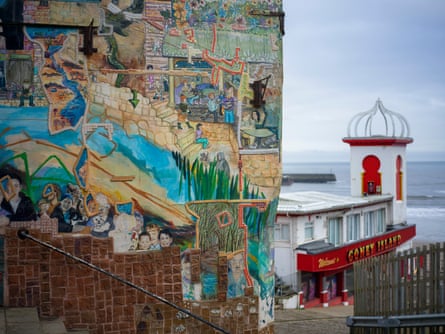
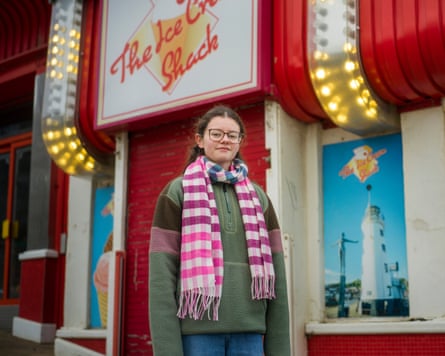
Scarborough’s Coney Island, a traditional amusement arcade converted from the old Marine Baths swimming pool

-
Emily, 29, says a better rail link to jobs in York would create more of an incentive for people to stay and contribute to Scarborough. Daisy, 19, who works for a local arts charity, is pleased to have a proper long-term job in town
Nineteen-year-old Daisy, who also works for Arcade, commutes to Scarborough from Bridlington by car as she finds the train “not the most reliable”. She is glad to have found long-term regular employment locally.
Working in the winter months is a whole new experience for her. “I’ve never worked at this time of year before because every other job I’ve had, like in a gift shop on the harbour and that sort of thing, it’s always been seasonal,” Daisy says.
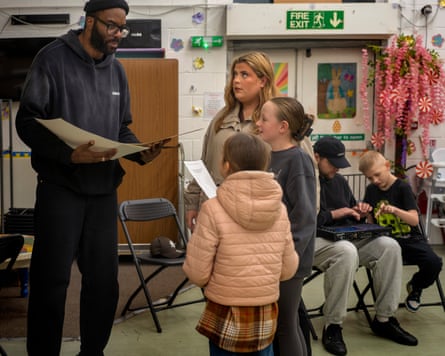
Arcade helps communities to get involved in the arts and creativity, and Daisy and Emily have set up an event at the Gallows Close community centre in the Barrowcliff neighbourhood, which is tonight hosting Chiedu Oraka, a rapper from Hull who calls himself “The Black Yorkshireman” and recently supported Coldplay on their UK tour.
Alongside musicians from a professional orchestra, he is helping a group of children ranging in age from eight to 17 to compose their own song about where they live.
-
The Hull rapper Chiedu Oraka at a children’s workshop at Gallows Close community centre, with a volunteer, Stacey, 24; Farrah, 10, (in pink); and Teyha, 10
“I despise the way these sorts of [left behind] places are talked about in the media and elsewhere,” says Oraka, in a break from working with the children. “But I also know there will be so many young ‘hidden gems’ in places like Scarborough because, these kids, they’ve got so much to say.”
It is something he is hoping to tease out of the children surrounding him. “What does Barrowcliff mean to you?” he asks.
“It’s a bit scary round here,” says one. Another adds: “It’s all right.”
Oraka says: “When I was your age, I used to say ‘it’s all right’ about where I lived too. “But it [the north Hull estate he grew up on] has given me everything. People said I wasn’t good enough and I proved them wrong. And that’s what I want you lot to prove as well.”
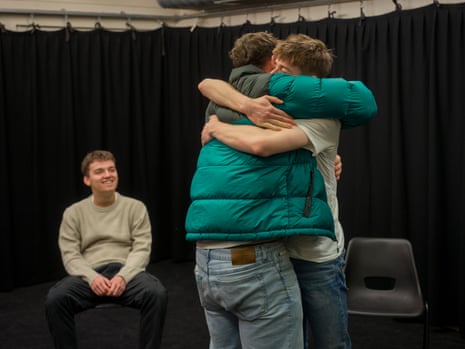
Back at the Stephen Joseph theatre, Keane has just finished rehearsing the passage at the end of Feral where Adam is about to board the train to Leeds. If he makes it to London, how will he feel to be on the train out of Scarborough?
“When Adam gets on the train, only part of him does,” says Keane. “A part of him stays in Eastfield. And really, there couldn’t be truer words. When I leave here, there’s always going to be a part of me that stays behind.”
-
Jack looks on as Keane and Charlie embrace after rehearsing Keane’s play Feral at the Stephen Joseph theatre
Additional reporting by Antonia Shipley
The Against the tide series is a collaboration between the Guardian and the documentary photographer Polly Braden and reports on the lives of young people in coastal communities across England and Wales