4 hours ago
10
4 hours ago
10
The Red Cross has said at least 93,000 people may have been affected by Wednesday’s flash floods on the Nepal-Tibet border, which have killed nearly 600 people, left another 1,900 missing, and triggered a huge rescue operation that is being hampered by fears of new flooding.
The International Federation of Red Cross and Red Crescent Societies (IFRC), the world’s largest humanitarian network, said it feared the death toll would continue to rise as some of the hardest-hit areas remained inaccessible after roads and bridges were destroyed by the torrents.
“The trauma of this event is enormous,” David Fisher, the IFRC head of delegation for Nepal, said on Friday.
“Thousands of homes have been destroyed or suffered significant damage. We believe that at least 93,000 people have been affected and are in great need. The death toll is very high and unfortunately likely to continue to rise.”
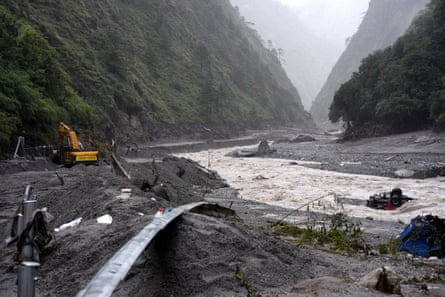
The deadly floods occurred on Wednesday morning after an enormous section of a glacier in the Himalayas broke loose and crashed on to the valley floor in Nepal’s Langtang national park, unleashing a massive surge of water, mud, rock and ice that thundered down rivers and valleys. The resulting floods obliterated villages and destroyed power stations, roads and bridges.
Nepal’s steep slopes and the lush valleys below are especially vulnerable to flooding and landslides, and extreme weather events, such as intense monsoons, and melting glaciers have become more common because of warming due to human-caused climate change.
“The damage is just incredible,” Lila Pieters Yahia, the UN resident coordinator for Nepal, said on Friday, adding that more than 40 bridges had been destroyed or badly damaged and “over 40km of road completely destroyed”.
By Friday afternoon, the death toll stood at 584 people: 579 in Nepal and five across the border in Tibet, China. Authorities in Nepal said 1,942 people were still missing, including hundreds of foreign nationals who were in the area to work, trek with guides or make a pilgrimage.
Rescue teams have reported finding bodies hundreds of miles downstream from the disaster zone in the Chitwan district of Nepal, near the Indian border. Dozens of injured people were transported to Kathmandu for advanced medical care and more than 100 people were rescued by Nepali army personnel in helicopters.
Rescuers were forced to suspend operations on Friday morning after a dam of debris overflowed on Friday, increasing the risk of further flooding. Residents in Nepal’s Rasuwa district, on the border with Tibet, were seen rushing up hillsides to escape a possible surge in the river, according to witnesses.
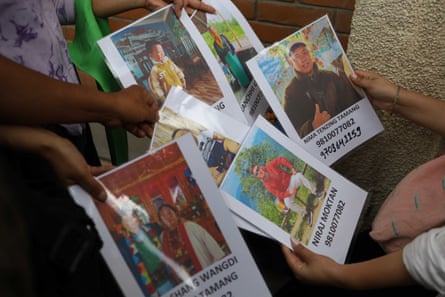
The Chinese state broadcaster CCTV reported that a lake formed by piles of debris from the mudslide had begun overflowing on Friday, sending water towards the area where rescue teams were headed, and forcing a brief pause in operations.
Rescue efforts in Bidur, the capital of the Nuwakot district in Bagmati province, Nepal, were disrupted on Friday morning as the Trishuli River began to rise again after the lake near the border overflowed.
Rescue workers were moved from the area and people who had tried to return to what remained of their homes were told to evacuate again immediately.
Bidur, once a bustling town on the banks of the Trishuli, now lies in ruins. Most homes were washed away when mud, rocks and debris surged down the river valley early on Wednesday. Survivors described clinging to buildings and trees as the water rushed over them.
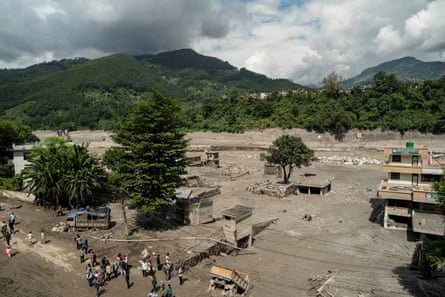
The mangled concrete remains of a bank, a government office and an ATM booth were among the few structures left standing, although they were submerged in mud. Officials said there were bodies inside the buildings but it was too dangerous to recover them.
Nearby, people gathered along the muddy road, calling out for lost relatives and trying to dig out what was left of their belongings.
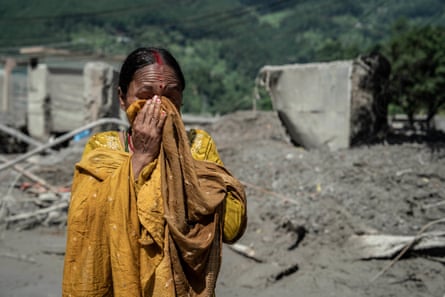
Most areas battered by the flash floods remained accessible only by army helicopter. At the Bidur army camp, from where much of the rescue effort was being coordinated, rescue and military helicopters flew in and out every five minutes, bringing in dozens of traumatised victims. Many said the floods had taken their loved ones, their homes and everything they owned in a matter of minutes.
The international community is scrambling to get aid to flood-stricken parts of Nepal and Tibet.
Nepal has said it does not yet need foreign assistance as the search and rescue operation – complicated by the destruction of bridges and roads across the mountainous region – continues.
“The offer for help is natural,” Lok Bahadur Chhetri, a spokesperson for Nepal’s foreign ministry, said on Friday. “Our security agencies are doing the search and rescue operation. For now we don’t require such help.”
The Kathmandu Post reported that India, China, the US, Britain, Japan, South Korea, Sri Lanka and Bangladesh had asked the government to allow their search and rescue teams to assist in the operation.
Dinesh Bhattarai, a former Nepali ambassador to the UN in Geneva, said the government’s reluctance to accept foreign assistance may be linked to sensitivities over Rasuwa district and its border with Tibet.
“They may have thought about the locational sensitivity of the region and decided not to accept foreign teams,” Bhattarai told Reuters.
But Chhetri said Nepal’s own rescue teams were handling the operation and the decision to refuse foreign assistance had nothing to do with sensitivities.
Scant information has emerged from Chinese authorities about the scale of the destruction in Tibet, the most tightly controlled part of China even under normal circumstances. Only brief, state-controlled media reports about the floods have been allowed to circulate in China and the authorities have confirmed only five deaths there. Chinese reports have focused on rescue efforts.
With Agence France-Presse and Reuters