3 hours ago
11
3 hours ago
11
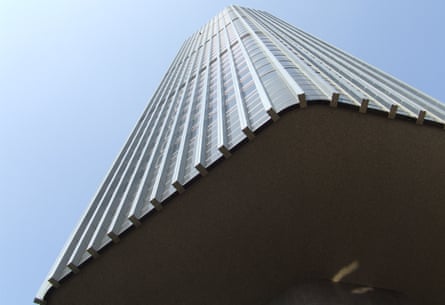
As a modern high-rise city, London had its skyline shaped through the acumen of the pioneering structural engineer Wilem Frischmann, who has died aged 95. Widely considered among the most influential engineers of his generation, he was best known for his work with the modernist architect Richard Seifert. The 34-storey slab of Centre Point at the east end of Oxford Street, and the City’s NatWest Tower (now Tower 42), at 600ft high, once Europe’s tallest building, were landmark structures, establishing Frischmann’s reputation for engineering innovation.
Conventional wisdom held that London’s soft clay soil could not support high-rise towers, but Frischmann proved otherwise, developing the use of large-diameter piled foundations that made such structures achievable. “I was told you can’t build tower blocks on clay, so I made a point of showing that you could,” he told the Observer in 2018. The method involved drilling a series of closely packed piled foundations to distribute the building load. Frischmann would inspect the holes himself, and once got stuck in one, being obliged to spend the night there until finally extracted.
Centre Point, completed in 1966, also introduced precast concrete elements that served both as structure and facade, reducing the load on internal columns and eliminating the need for scaffolding. Slotted together like a colossal jigsaw, rising by a storey a week, the T-shaped concrete panels created an op-art patterned exoskeleton, though the architectural historian Nikolaus Pevsner sniffily described Centre Point as “coarse in the extreme”. It received Grade II-listed status in 1995.
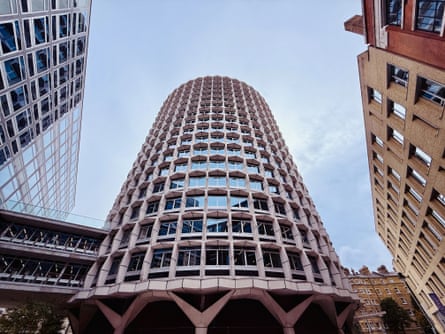
The imposing corncob of Space House in Kingsway, central London, another Seifert tower, employed similar structural design principles. Subject to an ambitious remodelling completed in 2024, it was extended by two storeys through the simple expedient of adding new layers of precast elements, demonstrating the integrity and ingenuity of its design. In a satisfying squaring of the circle, Frischmann’s firm, now the Pell Frischmann Group, was once again the structural engineer, going on to celebrate its centenary in the revitalised Space House earlier this year.
Frischmann first joined CJ Pell & Partners in 1958, becoming a partner in 1961 and chairman in 1968. With his long-time business partner, Sudhu Prabhu, he grew what was a modest, London-based engineering practice founded by Cecil Pell in 1926 into an internationally respected multidisciplinary consultancy employing more than 1,000 people. Although Frischmann stepped down as chairman in 2015, he continued to take an active interest in the firm until his death.
His preoccupation with high-rise structures led to him being commissioned by the Treasury to produce a report on the partial collapse of the 22 storey Ronan Point residential tower in 1968. A gas explosion in an 18th floor kitchen caused part of the tower to collapse like a pack of cards. Four residents were killed and 17 injured, undermining confidence in high-rise schemes that had proliferated across the UK in the postwar era, many featuring industrialised large panel systems of construction. Frischmann’s findings led to fundamental changes in how tall buildings in the UK were designed, built and regulated. As an advocate for the wider public understanding of structural engineering, he was interviewed by David Frost on national television explaining why Ronan Point had failed.
Other public commissions included a report on how to protect the City’s historic Mansion House against ground movement caused by the Docklands Light Railway extension, published through the Institution of Civil Engineers in 1994. This work established Pell Frischmann’s reputation as one of the UK’s leading consultancies for technically challenging engineering.
Such professional success belied the overcoming of almost unthinkable adversity in early life. Wilem Frischmann was born in Ungvár, then part of Czechoslovakia, now Uzhhorod in western Ukraine. His father, Lajos Frischmann, was of Hungarian Jewish descent; his mother, Nelly, was Ukrainian. Both perished in the Holocaust. As a teenager, Frischmann survived being deported to Auschwitz in 1944 and a subsequent death march to Buchenwald when the camps were dismantled by the Nazis towards the end of the war.
In 1945 he was repatriated to Uzhhorod and then went on to briefly study in Prague. He was offered a college place in Moscow but instead made the journey to Britain, where he attended Bunce Court school in Kent, founded in 1933 to educate the children of Jewish refugees.
Frischmann originally wanted to train as an architect, but had to compete with ex-servicemen given priority for higher education places after the war. Between 1947 and 1952 he attended the Hammersmith School of Building, where he shared digs with a fellow Jewish Hungarian refugee, George Soros, who was studying at the London School of Economics. Frischmann then joined Felix Samuely, a talented Austrian émigré and engineer known for his work on the Festival of Britain and his collaboration with Erich Mendelsohn and Serge Chermayeff on the totemically modernist De La Warr Pavilion at Bexhill. Frischmann worked on the British Pavilion for the 1958 Brussels World’s Fair, conceived as a striking assemblage of origami-like towers, eventually leaving to complete a postgraduate diploma at what is now Imperial College London and a PhD at City University.
Frischmann’s technical contributions reshaped what was thought possible in structural design. In the early 1980s he was fascinated by the idea of a crossing over the English Channel, asserting that it might be achieved by a bridge, rather than a tunnel. He also worked on an unbuilt proposal for a bridge over the strait of Messina, linking southern Italy with Sicily. Long before the current US/Iran conflict, he suggested constructing a canal across the narrow tip of the UAE to bypass the strait of Hormuz, an initiative which now looks astonishingly prescient.
In 1990, Frischmann was appointed CBE for services to engineering. He was also awarded fellowships from the Royal Academy of Engineering, Association of Consulting Engineers and Institution of Civil Engineers.
In 1957 he married Sylvia Elvey, a former model for Vogue. Serendipitously, Pell Frischmannn’s offices were next to those of Vogue. She predeceased him, and he is survived by their children, Justine, an artist and former musician, and Richard.